Monday, October 26, 2020

The Anthropause: How is it impacting wildlife?

By Richard B. Primack


“I have been sick for so long that I have almost forgotten what it is to be well.”  -Henry David Thoreau in his correspondence. 


In a recent article in CNN World, journalist Caitlin Hu poses the question, “Can nature heal itself? What the pandemic has shown us.”

In many places during the time of the pandemic lockdown, wildlife have become more active and widespread due to reduced human activity. However, at other locations, poaching levels have increased due to reduced enforcement and the need for rural people to find sources of income.  A major concern is also what will happen to national parks and the ecotourism industry now that revenues have declined precipitously.  

The pandemic lockdown offers an unprecedented opportunity to determine how reduced human activity affects conservation efforts. In particular, this will help us evaluate the effectiveness of conservation management and might suggest new management strategies once the pandemic is over.   

How will the pandemic affect the abundance and management of wildlife, such as this brown bear?
(Photo by Robert F. Tobler, Source Wikimedia Commons, license CC-BY-SA 4.0)


Tuesday, October 20, 2020

Springs are hotspots of biodiversity, but vulnerable to climate change

By Tara K. Miller


Springs are important ecosystems to support biodiversity. They are fed by groundwater and maintain more stable temperature and water conditions throughout the year than the surrounding landscape. These factors support a wide variety of plant species. However, springs are isolated – aquatic islands in a terrestrial landscape – which makes it harder for plants to disperse and move to find more suitable conditions as the climate changes.

As climate change progresses, the Subarctic mainland of Norway is expected to experience increased temperatures and precipitation, thus changing the suitability of spring habitats for different plant species.

A spring in Kvannfjellet in Balsfjord county, Norway.
Photo credit: Jutta Kapfer.

We expect that the species composition of plant communities in springs will change due to climate change. In order to measure the extent of the effects of climate change on these communities and to predict future risk, it is important to study which species are currently present in springs, and which conditions support the presence of different species. We recorded which species were present at 49 spring sites in northern Norway. We also recorded the conditions at the springs, including water quality conditions (water temperature, pH, and the pace of the water flowing from the spring), climatic conditions (air temperature and precipitation), and the spatial location of the spring (altitude and geographical coordinates).

A spring in Bentsjordskaret in Tromsø county, Norway, with Tara recording species data.
Photo credit: Jutta Kapfer.

We found that both climatic and water quality conditions were important for determining which species were present in which springs, indicating that as these conditions change with climate change, species may be forced to move to new springs with suitable conditions, or their numbers may decline.

Altitude was also important in determining where species were present. Therefore, altitude may be a limiting factor for plant species in adapting to climate change. For example, if a species is already located at the highest-altitude spring location or if there are no suitable spring sites located at nearby higher altitudes, it may be unable to disperse and migrate to a new, suitable habitat.

Identifying moss species requires a close look under the microscope

Our research gives us a new understanding of the conditions that are important for supporting the presence of different species in Subarctic springs.


Read the full paper here: PDF

Tuesday, September 29, 2020

Pandemic and then drought impact the woods

By Richard B. Primack

“Let a slight snow come and cover the earth, and the tracks of men will show how little the woods and fields are frequented.”  - Henry David Thoreau in his Journal.

The COVID-19 pandemic began in March.  Soon large numbers of people thronged to the Webster/Hammond Woods for some exercise and fresh air during the lockdown. While it was good that people were using the Woods, the hikers and mountain bikers widened existing trails and made many new trails. The Newton city government reacted by putting up signs stating that using bicycles and making new trails were not allowed.  By July, fewer people were coming into the Woods and human impacts were reduced. City officials are considering closing off the new trails later in autumn. 

A new trail formed in the Woods by hikers and bikers.

The city put signs to discourage biking in the Woods.


This summer also marked one of the most severe droughts in Boston’s history.  Streams and springs in the Woods ran dry. Black birch leaves turned yellow and began to fall in August, especially on the ridges. Leaves of coast pepperbush and sassafras were drooping with thirst. The soil was dry and cracked and mushrooms of all types were almost completely absent.  The forest was quiet as the drought was too severe to support an active community of birds and insects. Such extremes of weather are one of the predicted outcomes of climate change.

Sassafras leaves drooping due to drought stress.

Early yellowing of black birch leaves due to the drought.


For more details, see:

Newton Tab:

https://newton.wickedlocal.com/news/20200514/popularity-of-newtons-parks-during-pandemic

Boston Globe:

https://www.bostonglobe.com/2020/09/25/metro/with-record-temperatures-little-rain-severe-drought-has-gripped-much-new-england/

Monday, September 14, 2020

Monitoring noise pollution in cities and protected areas with smartphones

 By Lucy Zipf, Richard B. Primack and Matt Rothendler

 "Only in saner moments do men hear the crickets. It is a balm to the philosopher.”  -Henry David Thoreau in his Journal.

Noise is a pervasive form of pollution in urban areas that impacts the health and well-being of humans and wildlife. It is often difficult and expensive to monitor and map noise pollution, which limits the availability of noise data and excludes community members from engaging in monitoring efforts.

In a paper just published in PLOS ONE, we describe and demonstrate a low-cost noise monitoring method using smartphones that both engages and educates community members and produces detailed noise maps of urban landscapes and protected areas. The method was demonstrated using bio-blitz style, single-day citizen science events and also as a university-level environmental science field exercise.

The noise monitoring app on a smartphone.


Participants in a monitoring event receive maps showing where they need to record sound.


The maps provide a nuanced understanding of noise distribution through city streets and protected areas, highlighting key sources of noise, such as roadways. Our maps of the Fenway neighborhood of Boston, MA, document that cheering crowds at a Fenway Park baseball game create noise levels as high as 80 decibels, which is about as loud as a lawn mower, whereas a nearby park is much quieter.

A map of the Fenway area of Boston, which includes Fenway Park.

A pdf of the article may be obtained by clicking this link: Zipf L, Primack RB, Rothendler M (2020) Citizen scientists and university students monitor noise pollution in cities and protected areas with smartphones. PLoS ONE 15(9): e0236785. https://doi.org/10.1371/journal.pone.0236785

Monday, August 31, 2020

Macroscale patterns of flowering and fruiting phenology in China

By Richard B. Primack

“If you have built castles in the air, your work need not be lost; that is where they should be. Now put the foundation under them.” - Henry David Thoreau in Walden.

Patterns of phenology are increasingly examined at larger geographic scales with on-line databases and digitized herbarium specimens. In a recent paper in the Journal of Biogeography, Chinese colleagues and I examined the timing of flowering and fruiting of over 16,000 plant species from China using over 1,300,000 records.

Spiranthes sinensis, the Chinese ladies tresses, is a herbaceous orchid species 
that grows in China. (photos courtesy of Du Yanjun)

We found that across the geographic range of China, plant species flowered earlier and fruited later at lower latitudes and lower elevations. In comparison with herbaceous plants, woody plants flowered earlier, showed stronger geographic trends, and needed a longer time for fruit development.  Variation in flowering was most strongly affected by mean annual temperature in woody plants and by temperature seasonality in herbaceous plants.

Antiaris toxicaria, the arrow poison tree, grows in Chinese forests.

These results suggest that woody plants and herbaceous plants will respond differently to climate change, though this needs to be confirmed by investigating individual species and specific locations in greater detail.

This study is noteworthy for the enormous number of species, observations, and geographical scale included.

Thursday, August 27, 2020

A Flora of Home

By Tara K. Miller


After coming home during the COVID-19 pandemic, I decided to create a flora of the forest around my childhood home. A flora is a documentation of all the plant species in a location or region. 

Armed with 5-10 field identification books for trees, shrubs, herbs, and ferns, I spent hours wandering the forest, continually noticing new things in the woods where I grew up.

I picked out the tiny spring ephemerals, like spring beauties and trout lilies, that flourish before the trees leaf out.

Me and my field assistant with the spring beauties in early May


I waded through knee-high ferns, which I learned included wood ferns, lady ferns, and sensitive ferns.


I discovered that our forest boasts a few stray box elders and elms in an area dominated by maples, ash, and black cherry.

Black cherry trees are distinguishable by their “burnt-potato-chip-bark,” as my college ecology professor phrased it.


I ate wild strawberries, fought with invasive garlic mustard, and watched the eastern phoebes learn to fly.

Garlic mustard also makes a lovely pesto sauce


It’s never too late to gain a new appreciation of an old place.

Friday, August 21, 2020

Giant hibiscus flowers along the Charles

By Richard B. Primack

“How much of beauty - of color, as well as form – on which our eyes daily rest goes unperceived by us!”  -Henry David Thoreau in his Journal.

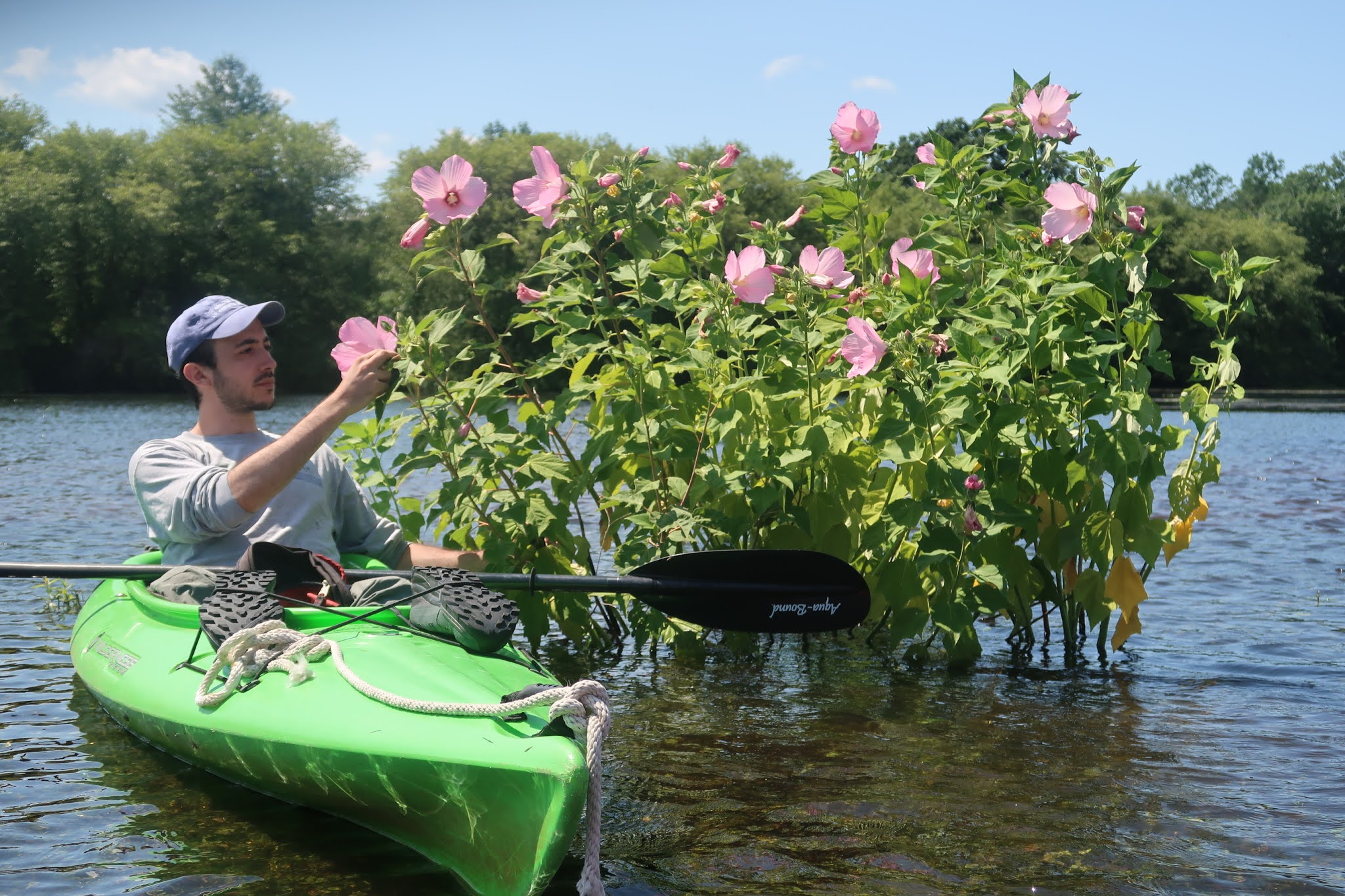
Thousands of rose mallow plants with huge flowers the size of dessert plates flower in early August on the banks of the Charles River in Newton, Needham, Waltham, and Dedham. The plants are typically 3 to 7 feet tall, and dozens of stems can grow in a clump.

Rose mallow plants emerging from the Charles River

Rose mallow flowers are usually pink, but some plants produce flowers that are darker pink, others lighter pink, and some are white. Many flowers have red markings at the base of the petals, forming a striking bull’s eye, and flowers can vary from 3 to 7 inches across.

White and pink flowers produced on neighboring plants.

Along the Charles River, about one in three plants produces flowers with a red center, and one in ten has white flowers, usually with a red center. Plants with entirely white flowers can be found but are rare.

A rare white-flowered plant.

Rose mallows are probably increasing in abundance along the Charles, as they colonize areas from which invasive purple loosestrife plants have been removed and places where beavers have cleared away woody riverside thickets.

Different plants produce flowers of different color and size.

August is a great time to be out on the river and see our spectacular native rose mallow plants growing in the wild. It is a world-class wildflower display right here in Boston.

An article about rose mallows along the Charles recently appeared in the Boston Globe.