Friday, July 29, 2022

Drastic New England Drought

 By Selby Vaughn

“That [person] is the richest whose pleasures are the cheapest.”  Henry David Thoreau in his Journal.

New England has had a remarkably hot and dry summer, which is evident in much of the plant life throughout the Boston area. 

Coast pepperbush leaves droop as their wetland habitat dries out.

Due to the drought, many plant leaves are drooping and drying out, causing an early-onset senescence of plants which would normally take place in the autumn. 

A patch of dry, yellow, and wilting ferns. 

These drought conditions also affect fruit development, causing fruits like blueberries to shrivel up like raisins. This could lead to starvation among animals like squirrels and chipmunks that rely on these plants. 

Huckleberry plant with shrivelled fruit and dry leaves. 

The extreme high temperatures and drought we have seen within the past month may persist as climate change continues to affect our environment. While some plants may be able to withstand the drought, others may die from these extreme conditions. 


Friday, July 22, 2022

Conservation of Native Pollinators

 By Selby Vaughn


Katia Landauer, Prof. Primack and I visited conservation land at Breakneck Hill in Southborough to meet with Rob Gegear, a professor of ecology at U-Mass Dartmouth. 

Rob points out abundant native pollinators.

Rob is a huge advocate for creating more effective native pollination ecosystems, a more expansive system way of conserving native pollinators than more typical pollinator gardens. 

Rob's native pollination system.


The native pollination system which Rob has planted uses a wider diversity of native plants to encourage a wider diversity of pollinators. 

Meadowsweet, a plant favored by many native bees.

Most pollinator gardens tend to use ornamental plants and cater mainly to honeybees and common bumblebees. Rob’s garden, however, uses native plants favored by a wide variety of native pollinators, such as bee balm and shrubby St. John’s Wort. His goal is to create native pollinator systems that will increase native biodiversity and ecosystem functioning. 

Observing native pollinators in a natural environment.


Tuesday, July 12, 2022

Three Falls in One Park

 Richard B. Primack

“Who hears the rippling of the rivers will not utterly despair of anything.” Henry David Thoreau in his Journal.

Letchworth State Park, south of Rochester, NY, was established to protect the deep and immensely beautiful valley of the Genesee River.  The park is remarkable for having three spectacular waterfalls. The upper falls lies below an immense railroad bridge.

The upper falls

The wide middle falls lies below the historic Glen Iris Inn.

The middle falls

The Glen Iris Inn

The lower falls is in a deep gorge. Vultures and hawks circle above, riding updrafts from the gorge.

The lower falls


The steep sides of the gorge create highly varied local conditions supporting fifty tree species, making it one of the most diverse temperate forests in the world. 

Forests growing along the sides of the gorge

And yet this wonderland faces grave threats to its trees:  the emerald ash borer is killing the ash trees, and oak trees and other species are being defoliated by spongy moth caterpillars. And recently the woolly adelgid insect has arrived in the park, threatening to destroy the groves of hemlocks shading the forest paths at the top of the valley.  
Ash trees are dying due to insect attack

Monday, June 27, 2022

Pollination Collaboration

 Selby Vaughn


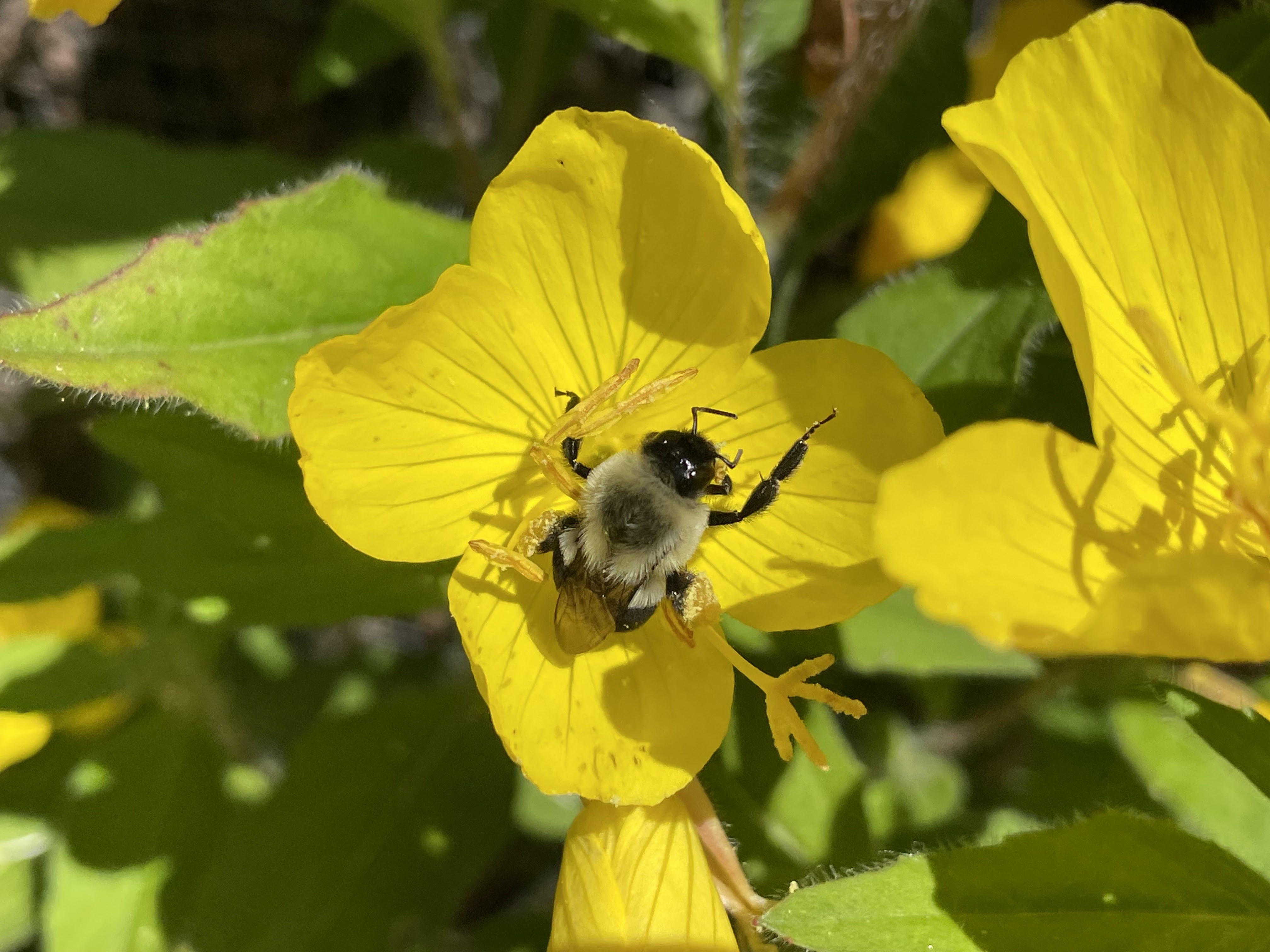
The Primack lab is investigating which pollinators are visiting plants around Newton, MA in order to determine if honeybees are outcompeting native pollinators. This work has been influenced by ongoing public debates about the keeping of honeybees and how it may promote pollination.  

A bumblebee pollinates a sundrop flower.

On June 22nd, we met in Newton with bee experts, Robert Gegear from University of Massachusetts at Dartmouth and Nick Dorian and his team from Tufts University, to learn from each other how to identify bumblebees and other species of native bees. 

The group collected and examined various bees to learn identification techniques.

The event included a lively discussion about the research of each lab group, and debates about the conservation value of pollinator gardens and other efforts to protect native pollinators.

A group photo taken in the Primacks' garden.


Tuesday, June 21, 2022

Late Leaves Live Longer?

Katia Landauer, Richard Primack, and Selby Vaughn

“If time is short then you have no time to waste.” Henry David Thoreau in his Journal.

With a warming climate, trees might become active earlier in the spring, and their new leaves might be at risk for being killed by a late frost. Even if a second crop of leaves is produced later, plant ecologists are concerned that the trees will not be able to grow as much or absorb as much carbon dioxide after losing their leaves. 

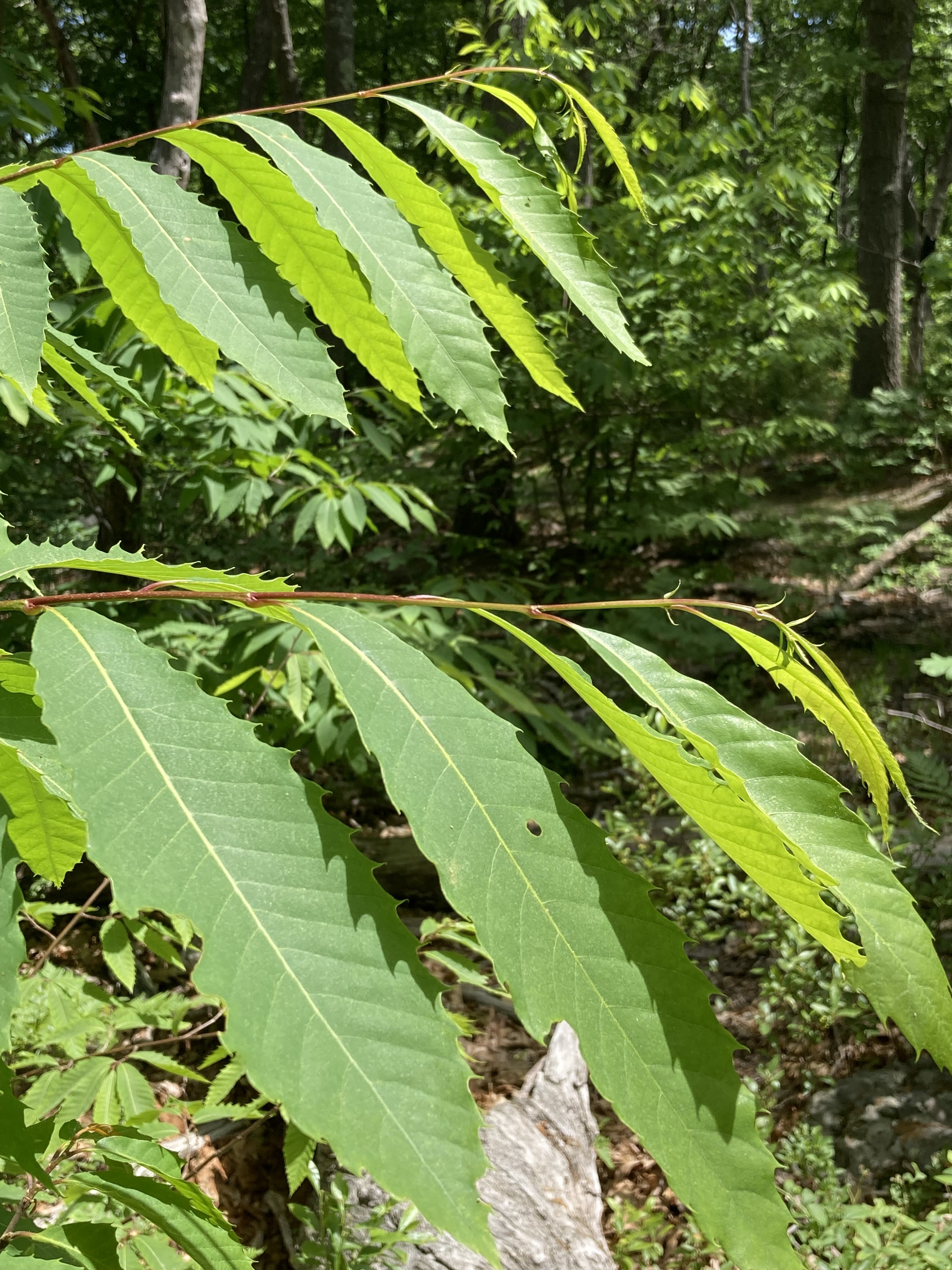
Normal leaves of a chestnut tree sapling


In a recent study by Zohner et al., potted tree saplings growing in greenhouse conditions underwent experimental cold treatments to simulate the effects of frost damage. The researchers found the surprising result that the second crop of leaves of beech and oak delayed chlorophyll breakdown in autumn; that is, they remained green longer than leaves on undamaged control plants. The extended longevity of second-crop leaves perhaps reduces the carbon budget effects of spring frost damage. 


Chestnut leaves several days after crushing to simulate the effects of a late frost

We decided to replicate this experiment under more natural conditions using oak, maple, sassafras, birch, and chestnut saplings growing in a forest in Newton, MA. To simulate frost damage, we crushed and later cut off the leaves of experimental plants; in contrast, leaves were left untouched on control plants. 

Over the summer and fall we will monitor plants for new leaves and chlorophyll content using a chlorophyll meter. 

Will second-crop leaves produced later in the summer last longer in the autumn? 

Here is the citation:  
Zohner, C.M., Rockinger, A. and Renner, S.S. (2019), Increased autumn productivity permits temperate trees to compensate for spring frost damage. New Phytol, 221: 789-795.

Monday, June 13, 2022

Are Male Trees Making Trouble?

Richard Primack


“There is absolutely no common sense; it is common nonsense.”  Henry David Thoreau in Reform Papers.  

For several decades, Tom Ogren, a horticulturist from California, has claimed that the worsening problems of allergy across the USA are due to government officials planting only male trees in cities.  In his view, “botanical sexism” has led to city trees producing an excessive amount of pollen with disastrous consequences for people suffering from allergies. 

As pointed out in a recent article in the Boston Globe, his theory is actually almost entirely wrong. 

First of all, many common city trees, such as lindens, Norway maples, oaks, birches, and flowering pears, do not have separate male and female plants. 

Oak trees are commonly planted as street trees, but do not have separate male and female plants.

Second, for species with separate male and female trees, such as some maples, ashes, junipers, and sassafras, government officials don’t just plant male trees as he claims. 

Thirdly, many common street trees, such as cherry trees, flowering pears, and crabapples, are insect pollinated, and don’t contribute to allergy problems. 

Flowering pear trees are insect pollinated, and don’t contribute to allergy problems. 

Finally, Ogren claims that planting more female trees would reduce pollen in the air because the female flowers would capture the pollen from the air. This is not tree, as the stigmas of the female flowers of wind-pollinated trees, such as oaks, probably only capture less than one in a million of the pollen grains released into the air.  

So while Ogren’s ideas are dramatic and lurid, they lack common sense. 


Thursday, May 19, 2022

Thoreau for Children

Richard B. Primack


“I suspect that the child plucks its first flower with insight into its beauty & significance which the subsequent botanist never retains.” Henry David Thoreau in his Journal. 

I Begin With Spring: The Life and Seasons of Henry David Thoreau is a new children’s book by Julie Dunlap.  The unique life of Thoreau is effectively presented for children using his observations of animals and plants throughout the year as an entry point. 

Figure 1. Cover of the book.

Larger issues of the time that engaged Thoreau, such as the fight against slavery in the United States and Darwin’s theory of evolution, are important themes in the book. The book also connects Thoreau’s observations to the current concern for global climate change, summarizing the research work of our lab group on changing flowering times in Concord. 

Figure 2. Drawing of highbush blueberry.

 The book is visually beautiful with colorful illustrations of plants and animals that make the book especially welcoming. 

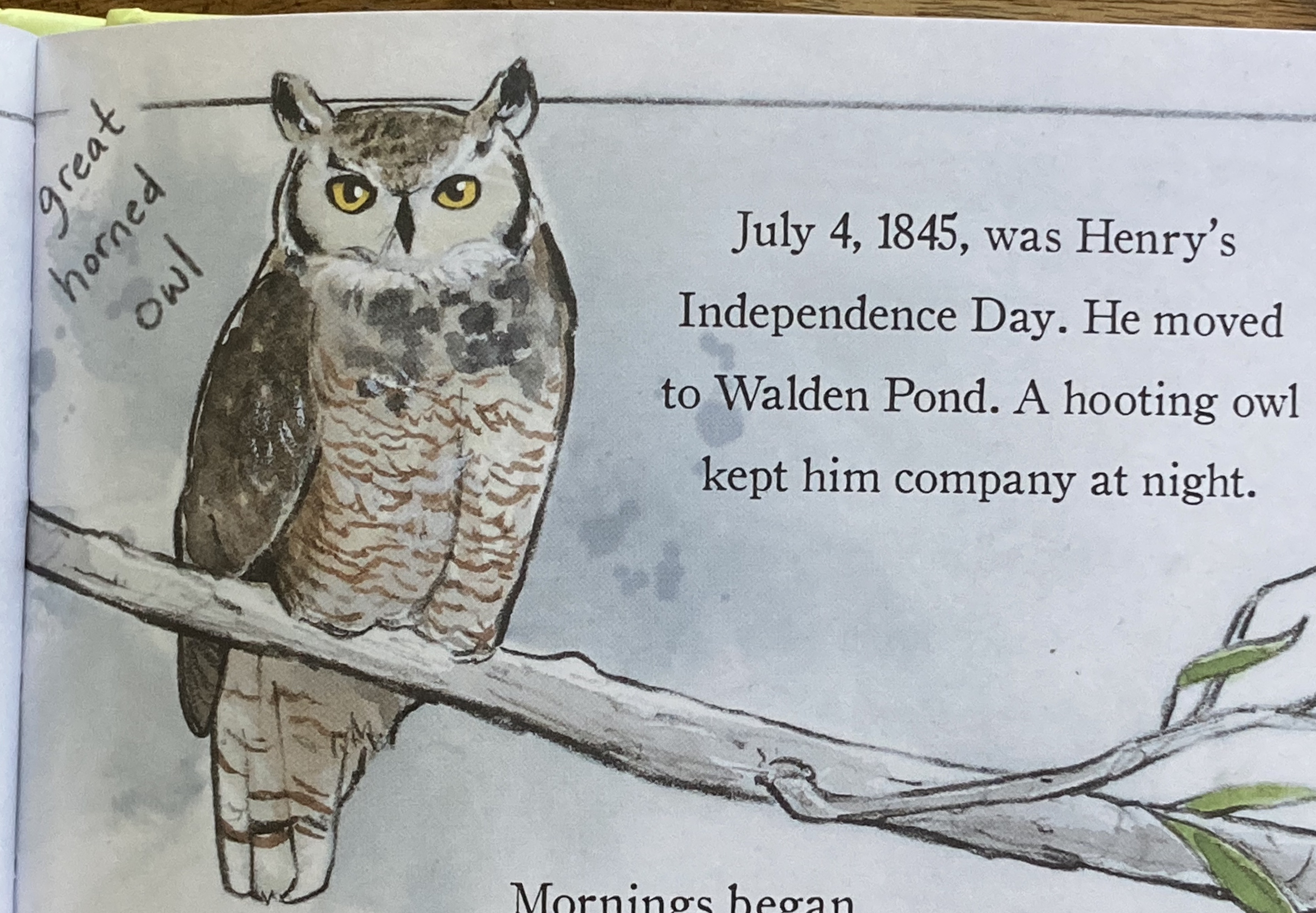
Figure 3. Drawing of a great horned owl. 

 This is a wonderful book for introducing children to phenology and nature study, and their connection to climate change and larger social issues.