Thursday, May 19, 2022

Thoreau for Children

Richard B. Primack


“I suspect that the child plucks its first flower with insight into its beauty & significance which the subsequent botanist never retains.” Henry David Thoreau in his Journal. 

I Begin With Spring: The Life and Seasons of Henry David Thoreau is a new children’s book by Julie Dunlap.  The unique life of Thoreau is effectively presented for children using his observations of animals and plants throughout the year as an entry point. 

Figure 1. Cover of the book.

Larger issues of the time that engaged Thoreau, such as the fight against slavery in the United States and Darwin’s theory of evolution, are important themes in the book. The book also connects Thoreau’s observations to the current concern for global climate change, summarizing the research work of our lab group on changing flowering times in Concord. 

Figure 2. Drawing of highbush blueberry.

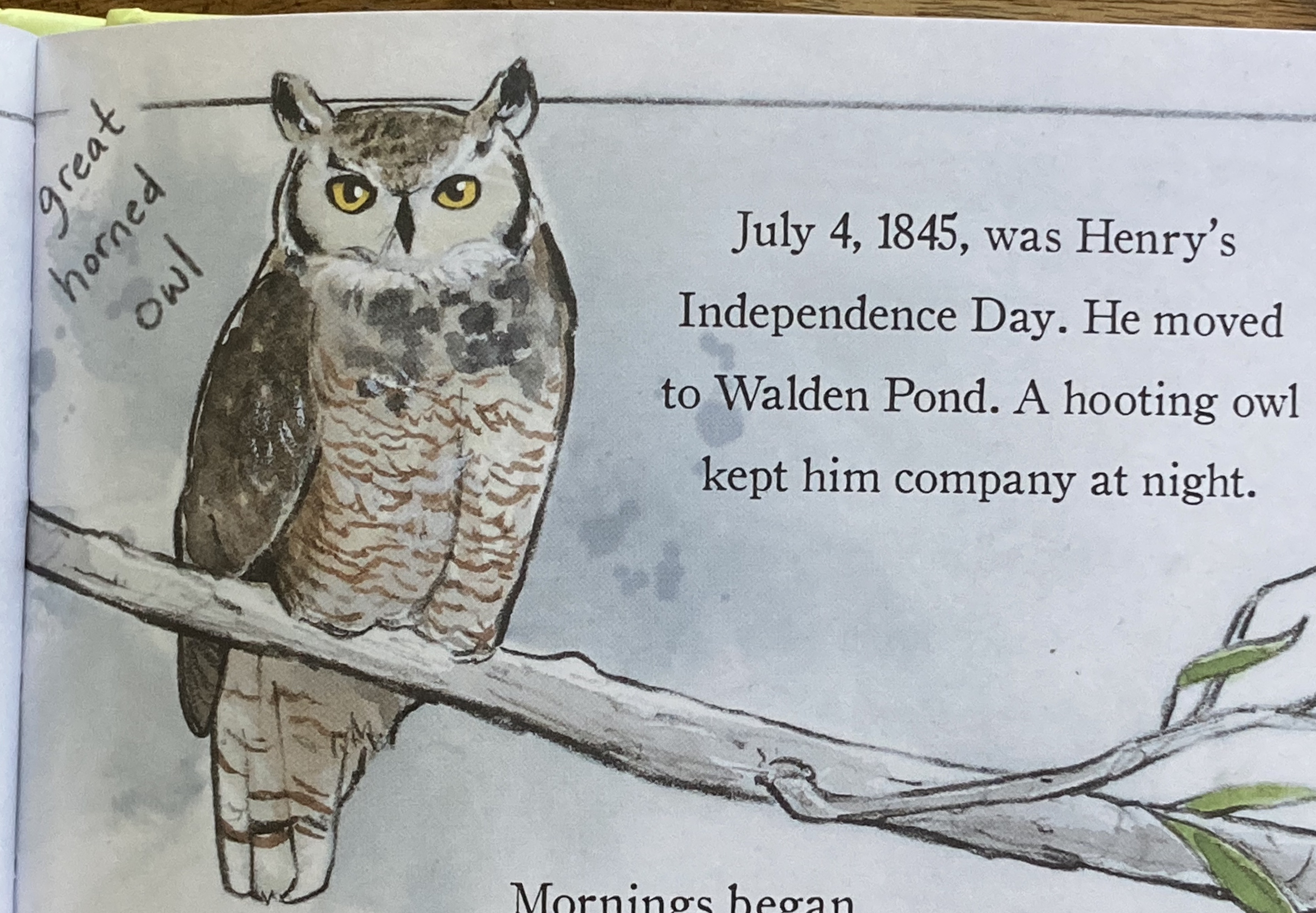
 The book is visually beautiful with colorful illustrations of plants and animals that make the book especially welcoming. 

Figure 3. Drawing of a great horned owl. 

 This is a wonderful book for introducing children to phenology and nature study, and their connection to climate change and larger social issues.  


Monday, April 25, 2022

Long Term Ecological Sites Investigate Pandemic

Richard B. Primack 


“Those who are ready to go are already invited.”  Henry David Thoreau in his Journal.
In a recent paper in Ecosphere, scientists describe how the U.S. Long Term Ecological Research (LTER) Network can be used to investigate ways in which ecosystems and ecosystem processes might be affected by the anthropause, the reduction in human activity associated with the COVID pandemic in 2020 and 2021. 
Long-term research from high-latitude/altitude locations (e.g., Niwot Ridge, North Temperate Lakes, Bonanza Creek, and Arctic LTER sites) shows that large between-year variability and underlying long-term trends prevent the early detection of COVID-related effects on phenology, gross primary production, and other ecosystem attributes. 
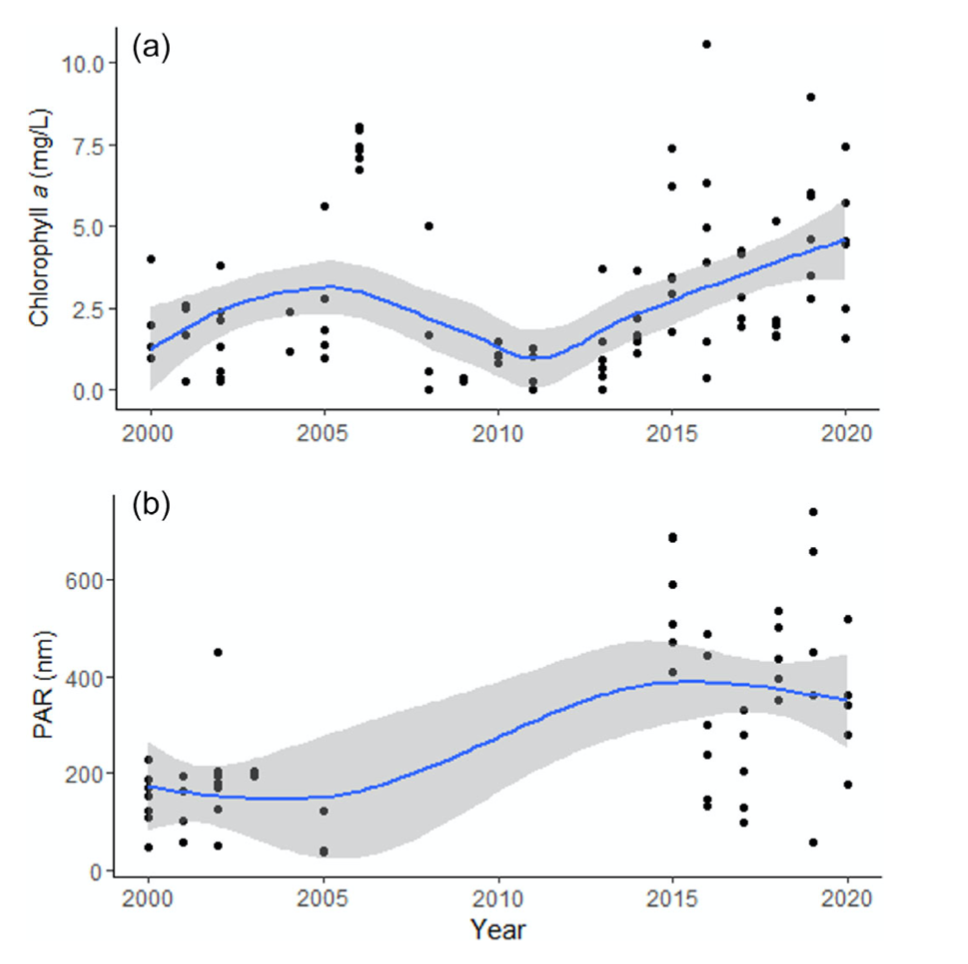
Figure 1.  Chlorophyll content and Photosynthetically Active Radiation (PAR) did not change in a lake at Niwot Ridge during the 2020 pandemic.
Figure 1.  Chlorophyll content and Photosynthetically Active Radiation (PAR) did not change in a lake at Niwot Ridge during the 2020 pandemic.

Research at the Georgia Coastal Ecosystems LTER reveals that increased home septic system use and agricultural waste (unharvested and decaying crops) likely increased nutrients in estuaries, resulting in rapid green-up of marsh vegetation. 
Figure 2.  The Enhanced vegetation index (EVI) increased in Georgia coastal marshes during the 2020 pandemic.
 

At three LTER aquatic and marine sites (1) the Santa Barbara Coastal LTER in southern California, (2) the North Temperate Lakes LTER in Wisconsin, and (3) the Moorea Coral Reef LTER site in the central South Pacific Ocean, the different spatial scales of human behavior and the varying connectivity of animal populations prevent easy generalizations from being made about the ecosystem effects of the pandemic.

Figure 3.  Fisheries practices and animal populations are striking different at contrasting LTER sites, obscuring the effects of the pandemic.

These case studies show how long-term ecosystem studies can potentially be used to distinguish the short-term impacts of the pandemic from inter-annual variation and long-term changes in ecosystem pro-cesses.
Published in Ecosphere journal. 

 DOI: https://doi.org/10.1002/ecs2.401 


Monday, April 11, 2022

Primack presents to National Science Teachers Association

“It is folly to attempt to educate children within a city. The first step must be to remove them out of it.” Henry David Thoreau in his Journal. 

On April 2, Professor Richard Primack presented a keynote address at the National Science Teachers Association annual meeting in Houston, Texas. His talk, Walden Warming: Climate Change Comes to Thoreau’s Concord, provided an overview of the research that he and his students have been doing over the past 20 years with support from the National Science Foundation.  


Richard Primack at the conference along with David Foord and Lisa Janeway from the Brandwein Institute.


As he describes, “I spoke about how a warming climate is causing the plants of Concord, MA, to flower and leaf out earlier now than in the time of Henry David Thoreau in the 1850s. I tailored my talk to emphasize projects that science teachers could use to help their students investigate the biological effects of climate change, such as the use of twig experiments.”


Boston University undergrads Selby Vaughn (left) and Taylor Reagan evaluating twig experiments in the Primack lab. 


Because of the pandemic, this was the first time in three years that the NSTA conference had been held in person. While the conference normally has around 10,000 attendees, this year there were just 4,000 people. Primack’s talk was sponsored by the Brandwein Institute, an environmental foundation.

Wednesday, March 23, 2022

Detecting flowering time response to climate change in Denmark

Richard B. Primack


“Let us spend one day as deliberately as Nature, and not be thrown off the tracks by every nutshell and mosquito’s wing that falls on the rails.” Henry David Thoreau in Walden.


Lots of new phenology data is becoming available from digitized herbarium specimens, citizen science programs, and photographs uploaded to the iNaturalist app. But how do these data sets compare in terms of detecting the effects of temperature and climate change on flowering times?  


A new study compares three separate phenology datasets from Denmark: i) herbarium specimen data spanning 145 years, ii) one year of flowering data collected from a citizen science program, and, iii) data derived from a year of photographs uploaded to iNaturalist. Each dataset includes flowering dates of three common plant species: Allium ursinum (ramsons), Aesculus hippocastanum (horse chestnut), and Sambucus nigra (black elderberry).


Photo:  Ransoms, horse chestnut, and black elderberry.


The iNaturalist dataset provided the most extensive geographic coverage across Denmark and the largest sample size, and recorded peak flowering in a way comparable to herbarium specimens. The directed citizen science dataset recorded much earlier flowering dates because the program objective was to report first flowering, and so was less comparable to the other two data sets. 


Figure 1: Distribution of data points across Denmark for: A) the herbarium dataset; B) citizen science dataset; and C) iNaturalist dataset. The herbarium data shows the widest range of temperatures. The iNaturalist data set has the most observations.

Herbarium data demonstrated the strongest effect of spring temperature on flowering in Denmark, possibly because it included year-to-year variation in temperature, while the other datasets only included one year of spatial variation in temperature across Denmark. Combining herbarium data with iNaturalist data provides an even more effective method for detecting climatic effects on phenology. Phenology observations from citizen science programs and iNaturalist will increase in value for climate change research once additional years are available.


This article is published as: 

Iwanycki Ahlstrand N, Primack RB, Tøttrup AP. 2022. A comparison of herbarium and citizen science phenology datasets for detecting response of flowering time to climate change in Denmark. International Journal of Biometeorology https://doi.org/10.1007/s00484-022-02238-w

Thursday, March 10, 2022

Forests changing slowly and quickly in Webster Woods

Richard B. Primack


“The higher the mountain on which you stand, the less change in the prospect from year to year, from age to age. Above a certain height, there is no change.” Henry David Thoreau in Familiar Letters


Some parts of the Webster Woods in Newton, Massachusetts, have not noticeable altered in my lifetime, and others have changed very quickly.


The history of the woods begins with the retreat of glaciers from Massachusetts about 16,000 years agoWe can still see evidence of the glaciers in the giant boulders they left behind in the woods. 


Boulder on Gooch’s Cave left behind by the glaciers.

For the last 400 years, hardy souls used the land for woodlots and pasture, as evidenced by the rock walls running through the woods These walls were likely constructed in colonial times and had wooden rail fences running along the top. 


Giant rocks forming a wall.

Other areas of the woods were extensively altered for water use. The canal emerging from Hammond Pond supplies water to the flooded meadow just south of the train tracks, which might have been managed for hay and cranberries in the past


Flooded field is linked to Hammond Pond by a canal. 

On the ridge and plateau above Hammond Pond and the plateau just to the west of Bare Pond, oak, black birch, and red maple trees are only about 20 to 30 feet tall with twisted, often broken trunks. The short, bonsai-like stature of these trees is likely due to thin, nutrient-poor soils. 


Stunted pitch pine tree on a ridge above Bare Pond. 

Big winds were responsible for toppling many of the oaks that fell. The Great New England Hurricane of 1938, with gusts of wind up to 186 miles per hour, knocked down many trees and broke the tops off others. Two years ago, a windstorm broke many trees (most weakened by disease). 


Oak tree broken in a windstorm. 

Other parts of the woods are being transformed more quickly. Just east of the Parkway, white pine saplings are rapidly growing up and forming thickets in the former deer park. Within a few decades, this field will become a pine forest. 


The ridge above Hammond Pond is also changing rapidly. The giant hemlock trees are sick and dying due to the introduced hemlock woolly adelgid insect, which infests their twigs, leaving behind dead branches. 


About four years ago, fire killed many small and medium-sized trees and shrubs, leaving the area more open. The roots of some trees, especially oaks and sassafras, survived and are producing new sprouts. 


Sassafras tree sprouting after a fire.

Tree diseases have also altered the Webster Woods. Chestnut trees were once common in the woods, but 90 years ago a fungus infected their stems and killed them, creating opportunities for young birch and oak trees to grow into the forest canopy. Fungal diseases are weakening beech, oak, and birch trees. These diseases reflect the declining health of our forests.


Diseased black birch tree with many fungal bodies. 


Now that the City of Newton has acquired the remaining block of undeveloped forest from Boston College, the future of the Websters Woods seems more secure. However, the people of Newton still need to monitor the woods and take action in response to ongoing and future threats, such as fires, tree diseases, and the invasion of non-native native. 


This is a condensed version of an article published in the Newton Conservators Newsletter:


https://newtonconservators.org/wp-content/uploads/2022/02/Newsletter-2022-Spring-Forests-Changing-Webster-Woods.pdf

Sunday, February 27, 2022

By Richard B. Primack


“Those things for which the most money is demanded are never the things which the student most wants.” Henry David Thoreau in Walden


In the January 2022 issue of the journal Conservation Biology, Titus S. Imboma of the National Museum of Kenya reviewed the book Conservation Biology in Sub-Saharan Africa. He wrote:

“Renowned U.S. conservation biologist Richard Primack teamed up with his South African colleague John Wilson to write a book specifically for Africans. They are to be commended for it, and they succeed brilliantly.” 


Cover of the book.


“As a training tool for students and conservation scientists and managers, the book covers the value of scientific methods for long-term preservation of biodiversity and the need for employing creative structures in biodiversity management.” 


“The book, published by Open Book Publishers, is freely available in pdf format. The decision of the authors to make the book open access is highly commendable and makes it of major importance to biodiversity conservation in Africa by Africans. I recommend this textbook to African students, conservation personnel, policy makers, and everyone interested in nature conservation. Free distribution ensures a wide readership among African environmental scholars, researchers, and other practitioners.” 


“This book is currently the most comprehensive publication on conservation in Africa; provides a reference point for environmental scholars, wildlife biologists, conservationists, and policy makers working with the environment and wildlife of Africa; and is set to become a classic publication.” 


This book can be downloaded for free:  https://www.openbookpublishers.com/product/1013

Over the past 30 months, the book has been downloaded more than 36,000 times.

To read the full book review:  https://doi.org/10.1111/cobi.13879

Friday, February 18, 2022

Thoreau-ly Observed: 170 years of climate change impacts in Concord

By Richard B. Primack


“The first sparrow of the spring! The year beginning with younger hope than ever!” Thoreau in Walden. p. 310.


Henry David Thoreau was a climate change scientist! For eight years in the 1850s, Thoreau recorded the timing of flowering and leafing out of plants and the spring arrival of birds while walking around Walden Pond and Concord. Our research group and other naturalists have since added to this remarkable collection of observations. As a result, Concord has become one of the most intensively studied locations in the world and an iconic example for how climate change has affected plants, birds, and ecosystems. 


We have recently published this compiled dataset and made it publicly available in the journal Ecology. 


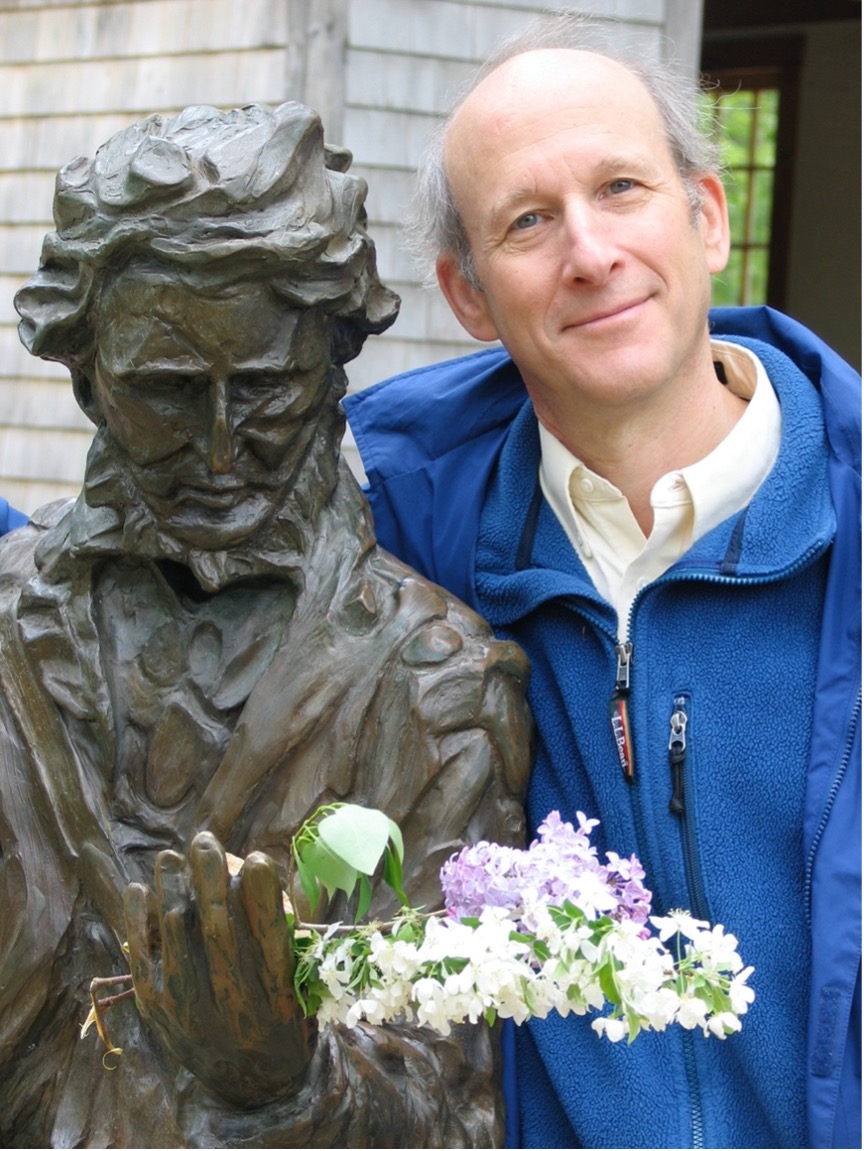
Richard Primack posing next to the statue of Thoreau at Walden Pond around 15 years ago.


Our papers based on this data set have demonstrated that warmer temperatures have caused plants to flower and leaf out as much as two weeks earlier than when Thoreau observed, but birds have changed much less.  Also, trees may be responding more rapidly than wildflowers to spring warming, and wildflowers may be getting shaded out.


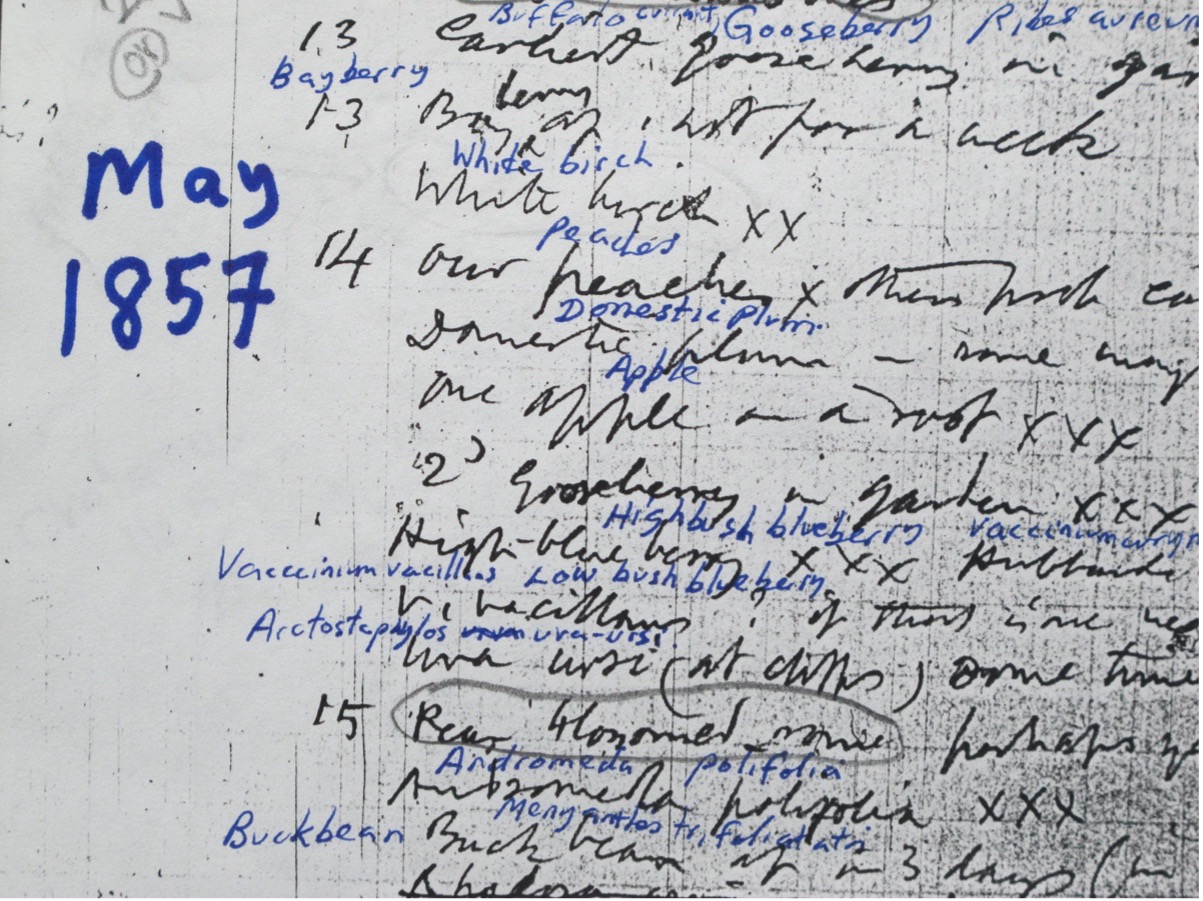
A page from one of Thoreau’s tables showing the first flowering dates of plants in May 1857.  Thoreau’s writing is in black, and Primack’s writing is in blue. For example, highbush blueberry was first observed to flower on May 14, 1857. 


By publishing this paper, we are encouraging other scientists and student to investigate climate change in new ways, and to connect with the life of Thoreau.


The article is available at: https://esajournals.onlinelibrary.wiley.com/doi/abs/10.1002/ecy.3646