Monday, August 14, 2023

A Walk through the Greenway

 By Selby Vaughn


“How much of beauty – of color, as well as form – on which our eyes daily rest goes unperceived by us?” Henry David Thoreau in his Journal.


This past summer, I had the opportunity to complete an internship in horticulture with the Rose Kennedy Greenway Conservancy in Boston. I learned a lot about native and nonnative plants, as well as urban park management.


Figure 1: The author posing with a bunch of lilies.


This past week, Professor Richard Primack visited the Greenway and we had a chance to walk through the park, exchange ideas with the horticulture team, and see all that the Greenway has to offer in terms of plants, public art, and community engagement.


Figure 2: Richard Primack poses with Lead Horticulturist, Julia Lloyd (left), and Ecological Healthcare Horticulturist, Valerie Stiles.


Figure 3: We learned from each other and observed pollinators throughout the park.

 During my internship, I have also been able to complete a pollinator monitoring project in the park to determine if honey bees seem to be outcompeting native pollinators. So far, honeybees seem to be greatly outnumbering native pollinators, especially in the more ornamental areas of the park.


Figure 4: A wildflower meadow planted on the Greenway includes habitats and other resources for native pollinators.


Figure 5: Honeybees are overly abundant in the park, and seem to be outcompeting native pollinators.


The Greenway is a wonderful example of sustainable horticulture, along with all that an urban park has to offer. I’ve learned a myriad of things working here this summer, and recommend visiting if you have the chance!


Figure 6: Maria Moleteni’s ‘Anti-monument’ is one of many interactive public art pieces throughout the park.


Figure 7: Professor Richard Primack and the author had a great time wandering the 17 acres of the Rose Kennedy Greenway.


Monday, August 7, 2023

Best Practices for Phenological Research

 By Richard B. Primack


I have lived some thirty years on this planet, and have yet to hear the first syllable of valuable or even earnest advice from my seniors. They have told me nothing, and probably cannot tell me anything to the purpose.” Henry David Thoreau in Walden.


The study of phenology, the seasonal timing of recurring life history events, is increasingly used to investigate the effects of climate change and other environmental changes on species and ecosystems. The field of phenology is rapidly expanding as new sources of data become available, such as digitized museum specimens, citizen science networks, historical data sets, and long-term weather records.

Figure 1. Japan has a wealth of historical and modern records of the timing of the cherry blossom festival.


We recently wrote a paper that aims to help researchers, especially those new to the field of phenology, understand what’s needed for effective phenological studies. We present ten best practices that can help researchers overcome common challenges and advance the study of phenology through better planning, data collection, analyses, and interpretation. These practices are appropriate whether researchers use existing data, collect new data, or combine new and past data. 


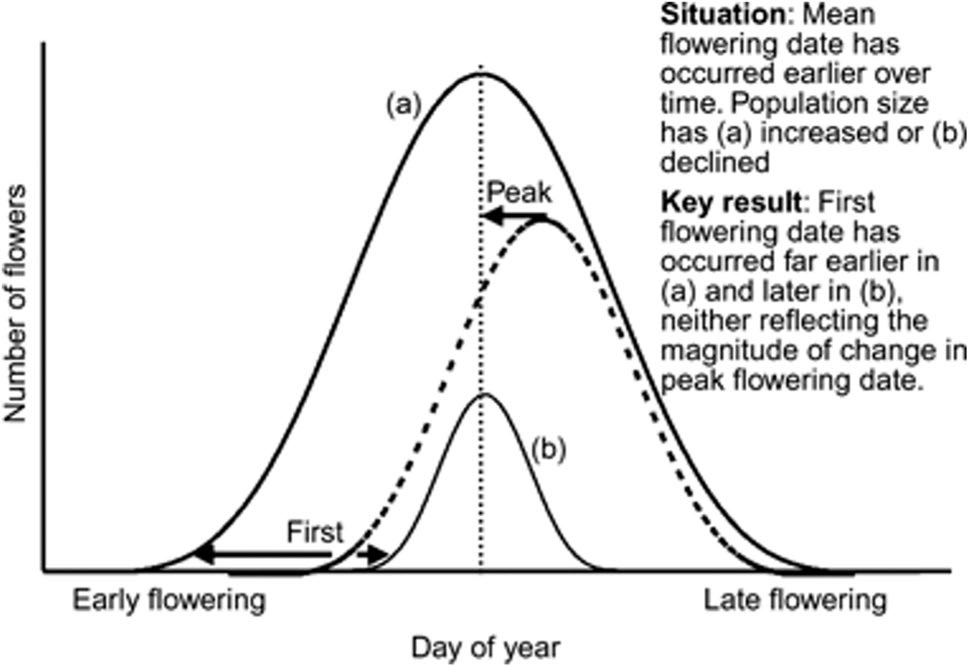
Figure 2. Changes in population size can have a strong effect on when the first migratory or flowering individual is detected in the spring.


Best practices:

1.     Ensure clear and consistent data collection protocols. 

2.     Be aware of data quality and biases. 

3.     Match data precision and duration to the question or application. 

4.     Utilize citizen science data and programs to maximize research benefits. 

5.     Avoid errors when combining or comparing disparate data sets. 

6.     Account for long-term changes in the study species. 

7.     Account for external factors that affect the study system. 

8.     Use statistics and models appropriate for the data and questions. 

9.     Ensure appropriate data are available when studying phenological mismatches. 

10.  Base new phenological theories on more comprehensive evidence. 


Here is a link to the full article: LINK


Monday, July 31, 2023

Overnight at the Moon

 By Richard B. Primack


“Truly the stars were given as a consolation to man.” Henry David Thoreau in Excursions.


The Moonrise Hotel in Saint Louis is unique in having a space-themed 1960s décor. People visiting nearby locations, including Washington University and the Saint Louis Zoo, might consider staying at this unusual hotel.  


Photo 1:  A moon replica emerges from the roof.


Photo 2:  The lobby stairs are illuminated in science fiction colors.


Photo 3. Giant photos of the moon enhance the lobby experience.


Photo 4.  Display cases feature scenes and objects from space exploration and popular culture.


Photo 5. Art objects inspired by science fiction, such as this futuristic radio, are encountered in the hallways.


Monday, July 24, 2023

Botanical Gardens More Beautiful with Glass Sculptures

 By Richard B. Primack


“To him who contemplates a trait of natural beauty no harm or disappointment can come.” Henry David Thoreau in Excursions.


The Missouri Botanic Garden has collaborated with artist Dale Chihuly since 2006 to enhance the beauty of its plantings with his glass sculptures. This special partnership is highly successful, delighting visitors and showing off glass sculptures and plants alike to great advantage. 


Photo 1.  A green tower draws attention to prairie plants.


Photo 2.  Red spears emerge from sand beds featured in a traditional Japanese garden. 


Photo 3.  A mass of orange curls highlights purple and red-hued plantings.


Photo 4.  Glass balls bring drama to a pond.


Monday, July 10, 2023

Century Plants Live for Decades and then Die

 By Richard B. Primack

“One moment of serene and confident life is more glorious than a whole campaign of daring. We should be ready for all issues; not daring to die, daring to live." Henry David Thoreau in his Journal.


Century plants get their name because they grow slowly for decades, perhaps even a century in some cases, and then flower spectacularly and die. As described in a recent article in the Washington Post, a century plant in Luthersville, Georgia, growing near the limits of its northern range, aroused great local interest this year when it sent up a giant 25-foot flowering stalk. 


Photo 1: The century plant in Luthersville with the flowering stalk developing. The photo on the left was taken in April and the photo on the right was taken in late May.


Century plants are often grown in warm, dry climates for their unusual rosettes of elongated grayish green spear-shaped leaves, each one up to six feet long. But a century plant really gets noticed when it reproduces after decades of growth, producing an inflorescence up to 30 feet tall, with clusters of yellow to orange flowers. 


Photo 2: The century plant flowering in early July.


The century plant puts so much of its stored water and nutrient resources into flowering and later fruiting, that it apparently dies in the months following. In fact, a flowering plant often produces small plantlets, or “pups,” on its stem at ground level, which can root and continue the life of the plant. 


Here is a link to the article: LINK


Monday, July 3, 2023

Long-term Phenology Research in the Rockies

 By Richard B. Primack


“Only that traveling is good which reveals to me value of home and enables me to enjoy it better.” Henry David Thoreau in his Journal.


Researchers at the Rocky Mountain Biological Laboratory (RMBL) in western Colorado conduct climate change and phenology research projects that are similar to our work in Concord, MA. To gain insights into their research and share with them about ours, I visited RMBL from July 25-28, where I met with many researchers and presented a talk. 


The location was exceptionally beautiful, with mixtures of meadow and forest in the valley and snow-capped mountains above. At this high elevation of 9500 feet, the sunshine was brilliant and the air was dry. There were around 200 people living and working at the lab, which was more than I expected. 


Among the researchers were:


Photo 1: David Inouye has studied plant phenology in fixed plots for 52 years.


Photo 2: Amy Iler investigates how seasonal snow melts affect plant demography, and Paul CaraDonna looks at bee population dynamics.


Photo 3: Dan Blumstein studies marmot behavior. Phil Cafaro, an environmental philosopher, traveled with me to RMBL.


Photo 4: Ian Breckheimer (left) uses drones to monitor vegetation.


Photo 5: Brad Taylor examines how the timing of snowmelt affects the hydrology of mountain streams. 


Photo 6: Olivia Vought studies how climate change is affecting the timing of ecosystem services.


Photo 7: Arturo Aguilar (center), myself (left), and others looking at pollinators.


For more information about the RMBL site visit: LINK


Monday, June 26, 2023

Angry Swan

 By Richard B. Primack

“It is true, nothing could originally demand our respect, which was not, at the same time, capable, in a greater or less degree, of exciting our fear, but this does not prove fear to be the source of that respect.” Henry David Thoreau in his Early Essays and Miscellanies.

My son Dan and I had a remarkable encounter with an extremely angry and protective swan while kayaking on the Charles River two weeks ago. As we rounded a bend in the river in Dedham, we observed a family of swans, consisting of two adults and three babies. We kept to the opposite bank of the river to keep as far from them as possible. Despite this, the bigger adult swan, presumably the male, swam aggressively towards us with its wings raised up.


Photo 1: Angry swan with wings raised. Optic Mag

For about 10 minutes, the angry swan kept trying to get very close to us from behind, presumably to peck us and scare us off. We faced our kayaks toward the swan, and also used our paddles to keep it at a distance of six feet away. The swan continued this aggressive behavior even as the current took us 50 yards from the babies. There was a slightly humorous quality to the encounter, but it was also surprisingly tense as the swam seemed intent on doing us harm. 


Photo 2: Angry swan flying to attack. RealMantis

Finally, the swan flew back to its family, and we laughed out loud in relief, thinking that the strange incident was finished. But a few minutes later, the swan flew back to us, even though we were now more than 100 yards away from the family and paddling in the opposite direction. The swan proceeded to confront us for another five minutes, again trying to get behind us. We were relieved when the swan finally flew back to its family. 

We did not take any photos or videos of this swan, as we were so concerned about our safety during the episode. But here are videos of other swan encounters:

Video 1

Video 2

Video 3