Friday, December 16, 2022

In Search of Thoreau’s Flowers: A New Exhibit at Harvard about Thoreau and Climate Change

 By Richard B. Primack   

The news that we hear, for the most part, is not news to our genius. It is the stalest repetition.”  

-Henry David Thoreau in “Life without Principle” 


A new exhibit at the Museum of Natural History at Harvard University, entitled “In Search of Thoreau’s Flowers” features our research using the records of Henry David Thoreau to study the effects of climate change. For the past 20 years, students and colleagues associated with our group have been carrying out fieldwork, analyzing data, and publishing papers on this topic.


Abe Miller-Rushing and Richard Primack at the exhibit 

The exhibit is a collaboration between scientists and artists to make the climate change message more accessible to the general public.


Henry David Thoreau made detailed flowering time observations during the 1850s, which we repeated over the past 20 years

The exhibit emphasizes how species in Concord are changing in their flowering times and their abundances over the past 170 years. Species which are most able to adjust their flowering times in response to a warming climate are able to persist in landscape.


Responsive species tend to persist in the face of climate change. Species not able to adjust, tend to decline.


Non-responsive species tend to decline.


Here is a link to the exhibit: 

Here is a link to a summary of our research on climate change in Concord: 

Ellwood, E.R., Gallinat, A.S., McDonough MacKenzie, C., Miller, T., Miller-Rushing, A.J., Polgar, C., and Primack, R.B. (2022). Plant and bird phenology and plant occurrence from 1851 to 2020 (non-Continuous) in Thoreau’s Concord, Massachusetts. Ecology 103, e3646.Link, PDF 

Thursday, December 8, 2022

Wildflowers losing out to trees with climate change

 By Richard B. Primack   

Books are the treasured wealth of the world and the fit inheritance of generations and nations.” Henry David Thoreau in Walden. And one could say the same about herbarium specimens. 


For spring woodland wildflowers, timing is everything as they flower early in spring before the trees leaf out. Come out too early and it's still winter; too late and it’s too shady under the forest canopy. 


But the timing of spring is increasingly affected by climate change. When trees leaf out earlier due to a warming climate, will the wildflowers shift too, or will they be out of luck?  


Bloodroot is a spring wildflower in Eastern North America.

In a recentNature Communicationsstudy, we used herbarium specimens from three continents to examine how wildflower flowering times and tree leaf out times have changed over time and in response to climate. 


Thousands of herbarium specimens from East Asia, Europe, and Eastern North America were evaluated to determine past wildflower flowering times (circles) and tree leaf out times (crosses).

We found that trees in North America are significantly more sensitive to warmer temperatures in the spring—meaning they shift their timing more—than the understory wildflowers. If this shift continues, the already-short period of full sunlight for spring wildflowers could get shorter with negative consequences for their energy budgets. 


In Eastern North America, wildflower flowering times are distinctly less sensitive to temperature than tree leaf out times, but this is not so in East Asia and Europe.

But in Europe, wildflowers and canopy trees seemed to be shifting at about the same rate. And in Asia, the understory wildflowers were shifting more than the trees—meaning they might actually get more light in a warmer future. 


Citation:  

Lee, B.R., Miller, T.K., Rosche, C. et al. Wildflower phenological escape differs by continent and spring temperature. Nat Commun 13, 7157 (2022). https://doi.org/10.1038/s41467-022-34936-9 

Thursday, November 17, 2022

Warmer temperatures are linked to mismatch among forest plants

 By Tara K. Miller and Richard B. Primack


“To say that a man is your Friend, means commonly no more than this, that he is not your enemy.”  

- Henry David Thoreau in A Week on the Concord and Merrimack Rivers 


Many plants are responding to a warming climate by leafing out and flowering earlier in the spring. However, mismatches may occur when species respond at different rates. 

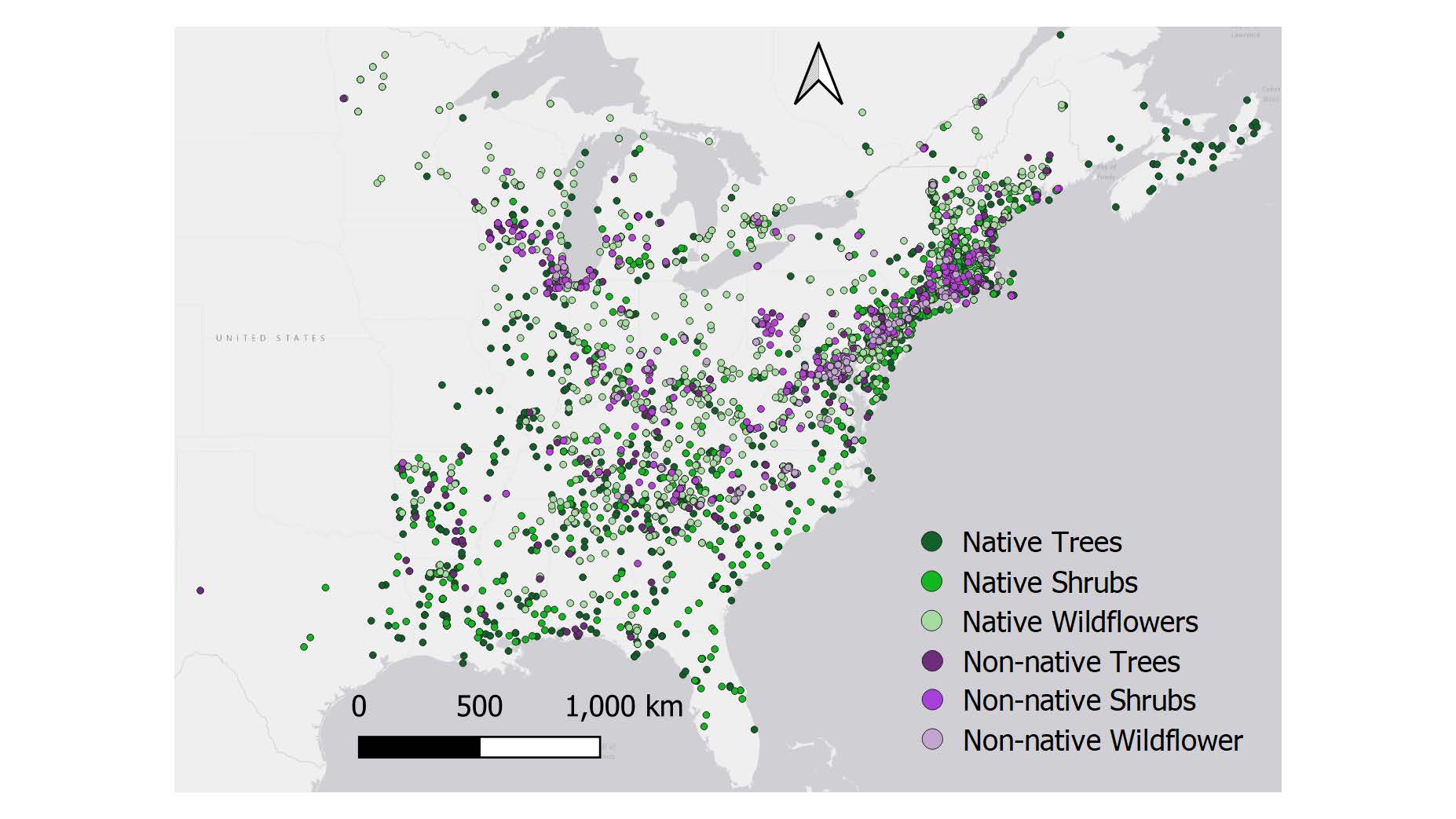
In a new study in Journal of Ecology, we showed that trees are shading out spring wildflowers across eastern North America by leafing out earlier in the spring in response to climate change. This might contribute to the loss of wildflower populations in coming decades as the climate continues to warm.

Native wildflowers, such as these Dutchman’s breeches,
are not keeping pace with trees as they advance
their leaf-out with warming temperatures
(© Andrew Cannizzaro CC-BY-2.0)

Many spring-blooming native wildflowers conduct most of their photosynthesis before the canopy trees above them leaf out and shade them over. As temperatures warm, trees and shrubs may block sunlight from reaching the forest floor earlier in the year, leading to a shrinking time period for native wildflowers to photosynthesize with full sunlight. Just a few days loss of sunlight access can mean a sizeable decrease in a wildflower’s carbon energy supply.

Our study confirms the results of an earlier study from Concord, MA that used the observations of Henry David Thoreau from the 1850s as a baseline, and extends the scope across eastern North America using data from herbarium specimens, which are pressed plants in museums.


Map of herbarium specimen collection
locations in eastern North America
(© Miller et al. 2022, Journal of Ecology)


Publication: Tara K. Miller, J. Mason Heberling, Sara E. Kuebbing, and Richard B. Primack. (2022). Warmer temperatures are linked to widespread phenological mismatch among native and non-native forest plants. Journal of Ecology. 


Sunday, November 13, 2022

Ethics of remote access and technology in conservation

 By Richard B. Primack 


“What is called charity is no charity but the interference of a third person.”  Henry David Thoreau in his Journal. 


Does remote access and use of technology in conservation- related programs and research provide the intended benefit to groups that have been marginalized in the sciences?  


Images of conservation activities. 


In a recent paper, we describe a typology of justice-oriented principles that can be used to examine social justice in three conservation areas: (1) remote access to US national park educational programs and data; (2) digitization of natural history specimens and their use in conservation research; and (3) remote engagement in conservation-oriented citizen science.  


Typology and examples of social justice-oriented principles applicable in conservation.


We found that remote access increased participation, but access and benefits were not equally distributed and unanticipated consequences have not been adequately addressed.


Thriving Earth Exchange is program that helps scientists and communities ensure that conservation projects benefit all participants.


The framework that we present could be used to assess the social justice dimensions of many conservation programs, institutions, practices, and policies, and related fields of ecology, evolution, and environmental sciences.   


Here is the article: 

Miller-Rushing et al. 2022. Conservation ethics in the time of the pandemic: Does increasing remote access advance social justice? Biological Conservation 276: https://doi.org/10.1016/j.biocon.2022.109788