Wednesday, March 1, 2017

Birding in Hong Kong, Vietnam, and Myanmar

Posted by Amanda Gallinat

One of the best parts of my recent trip to Southeast Asia was the birding! While the birds were at times evasive due to rain in Vietnam and the dense understory of tropical forests in Myanmar, the birds we did see were spectacular.

Southeast Asia is host to a diversity of kingfishers. One of the first birds we spotted at Hong Kong's Gold Coast Marina was a White-throated Kingfisher (Halcyon smyrnensis), flying between boats and fishing for its breakfast. In Vietnam, we added the Pied Kingfisher (Ceryle rudis) to our list, and saw the Collared Kingfisher (Todiramphus chloris) stealthily searching for fish in a lagoon in Myanmar.


White-throated Kingfisher at the Gold Coast Marina, Hong Kong

In Vietnam, we scheduled a full day of birding around Danang and Hoi An with wildlife biologist Luc Nguyen. This included a visit to Son Tra (Monkey Mountain) to look for birds. Unfortunately, it rained all day. While the birds made themselves scarce on Monkey Mountain, we did see plenty of --you guessed it-- monkeys!


Rhesus Macaque (Macaca mulatta) on Monkey Mountain, Vietnam

Red-shanked Douc Langur (Pygathrix nemaeus) on Monkey Mountain, Vietnam

Populations of the Red-shanked Douc Langur are estimated to have declined between 50-80% over the past 30 years throughout Southeast Asia, and the species is now listed as endangered. The WWF has been managing the population on Monkey Mountain in Danang as part of their conservation plan for the species.


We met up with Luc again on our last morning in Vietnam for a sunnier try at birding! We biked to nearby rice paddies along the Thu Bon river and saw many wading birds, as well as passerines/near-passerines foraging from perches, including shrikes, bee-eaters, and stone chats.

Sam and two great guides: Luc Nguyen and Birds of Southeast Asia, in Hoi An, Vietnam
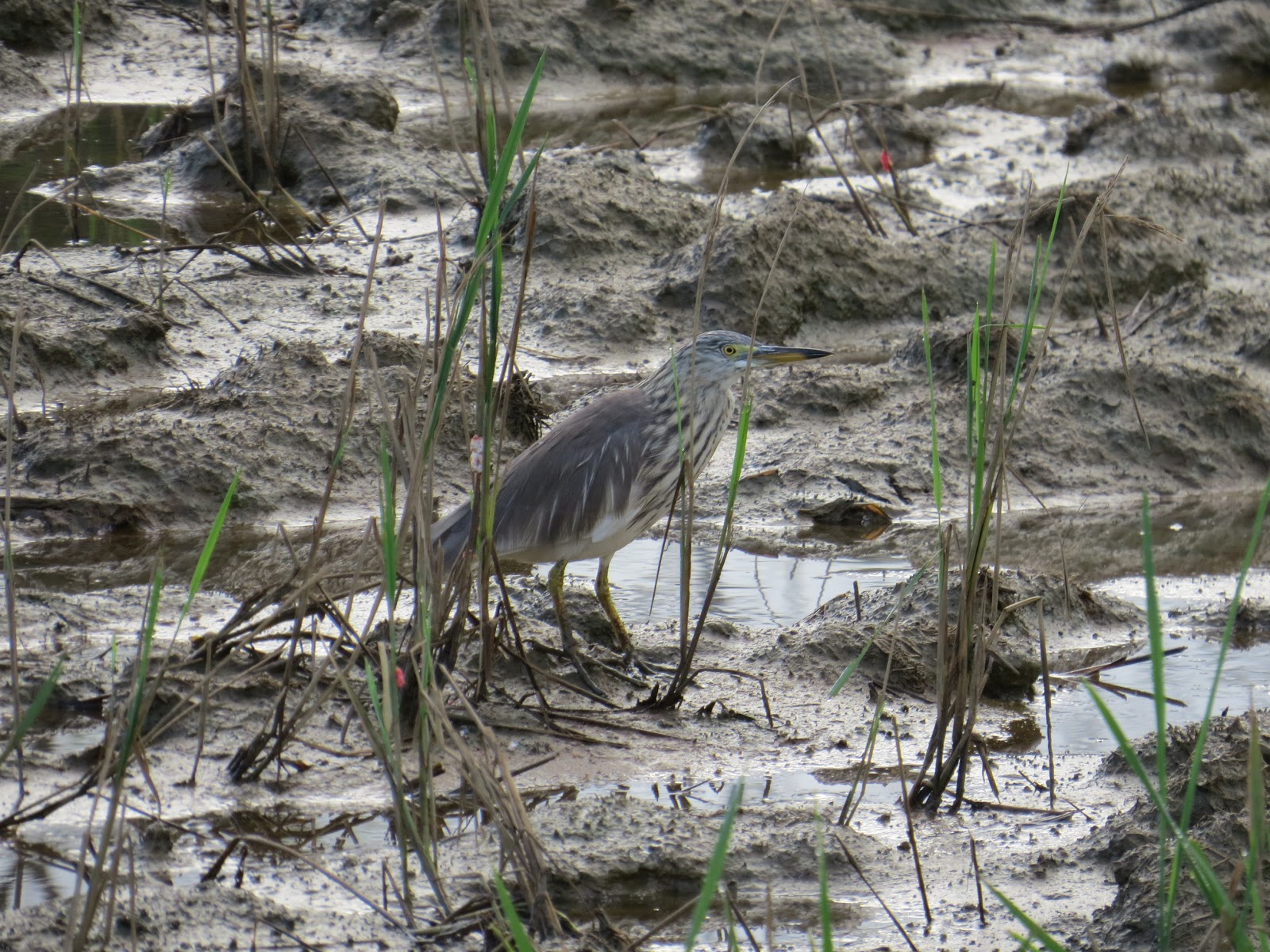

Chinese Pond Heron (Ardeola bacchus) in a Hoi An rice paddy, Vietnam


Green Bee-eater (Merops orientalis) by the Thu Bon river in Hoi An, Vietnam

Finally, we headed to Myanmar where we did most of our birding by kayak, around islands and lagoons. We saw several small groups of hornbills, often from a distance, and enjoyed the chance to identify some birds we'd never seen before, such as the Beach Thick-knee (Esacus magnirostris), Plain-throated Sunbird (Anthreptes malacensis) and the Crested Serpent-Eagle (Spilornis cheela).

Beach Thick-knee on a small island in the south of Myanmar

Plain-throated Sunbird on the forest edge of the same small island, Myanmar

Monday, February 20, 2017

Smith Fellowship


Posted by Caitlin McDonough MacKenzie


“The past  is the canvass on which our ideas are painted, - the dim prospectus of our future field. We are dreaming of what we are to do.”
Thoreau in Reform Papers.  

Exciting news!

I have been awarded a David H. Smith Fellowship from the Society of Conservation Biology for two years of postdoctoral research on the paleoecology of alpine and subalpine vegetation in Maine. 


Caitlin on Katahdin in Baxter State Park, Maine. 

Caitlin will be studying the history of alpine vegetation communities like this from a very long term (10,000 year!) perspective as a Smith Fellow. 


Under the mentorship of Dr. Jacquelyn Gill at University of Maine and Dr. Abe Miller-Rushing at Acadia National Park, I'll be coring ponds at treeline and counting pollen grains to understand how plant communities responded to past climatic changes over the Holocene. I will use the results to predict how Maine’s alpine plants will respond to future climate change, and make recommendations for the conservation of endangered species.

Thursday, February 16, 2017

European friends

Posted by Richard B. Primack

“To obtain to a true relation to one human creature is enough to make a year memorable.” 
-Thoreau in his Journal, 1851

During my trip to Europe, I visited with old friends and made new ones. Here are a few:


In Berlin, Birgit Nordt and I planned future projects monitoring phenology at botanical gardens. Above, Birgit points out extremely early flowers of winter aconite on the grounds of the Berlin Botanical Garden.


Outside of Koblenz, my old friends Sebastian Kelbling and Jurgen Dumont stand near a gate that diverts water from a small river into a spillway that powers an electrical generator. Jurgen’s family has owned the mill and surrounding land for many generations, and now makes money selling electricity and providing nature education programs.


Yordan Uzunov and Boyko Georgiev from the Bulgarian Academy of Sciences are working with me to produce a conservation biology book for Bulgaria. During my three day visit, they provided a wonderful introduction to Sophia and the country.

Thursday, February 9, 2017

German Experimental Ecology

Posted by Richard B. Primack
“There is no such thing as pure objective observation. Your observation, to be interesting, i.e. to be significant, must be subjective.” -Thoreau, 1854

The first stop of my three week trip was at the University of Greifswald in northeastern Germany. The University was founded in 1456, and the town has a beautiful market square. My hosts were Jurgen Kreyling and Andrey Malyshev.


Greifswald market square

Just outside of Greifswald is an experiment that reduces snow levels using a roofing system to simulate a future climate scenario. In contrast, Pam Templer’s group reduces snow cover with shovels. Which method is better? It turns out that each method is best for its own location: roofs are better when the snow is shallow (Greifswald), and shovels are best when the snow is deep (New Hampshire).

In a field experiment, roofing is used to simulate a future climate with lower snow cover

Another trip was made to the Friedrich-Schiller University in Jena, where I stayed at the Black Bear Hotel that Martin Luther had also visited 500 years earlier. 

In the lobby of the Black Bear Hotel, my friend Sebastian waves to Martin Luther

There is a famous biodiversity experiment on the outskirts of Jena, which shows that increasing the number of plant species in a plot increases the ecosystem services and productivity of the plot.

Jumping for joy at the Jena biodiversity experiment (click to enlarge photo for a better look at the experiments)

Most researchers visit the experiment in the growing season, but we jumped for joy at the chance to go on a winter field trip. I learned that the site has to be frequently weeded each year to prevent succession to woody vegetation, and to prevent invasion by other herbaceous species that were not planted. So, the long-term results are partially an artifact of the plots being very aggressively managed. Without this management, the results would be totally different.

Wednesday, February 1, 2017

Hong Kong: Life Finds a Way!

Posted by Amanda Gallinat

In January I traveled to Hong Kong, the city in which I grew up. Every time I return, something new strikes me about the city. For instance, my last visit, five years ago, was my first time returning as a birder, and I was delighted to see even common birds like the Black-collared Starling.


Black-collared Starling, photo by Sam Roberts (2011)

On this visit, I was struck by how much plant life is able to grow in Hong Kong's urban habitat. For instance, one of the regions of Hong Kong with the highest air pollution is the Central/Western district, where we saw banyan trees growing along the roadside.

Banyan trees on the roadside in Central, Hong Kong

Since the 1970's a common landslide prevention technique in Hong Kong has been to cover hillsides with concrete. However, in some areas such as the Tai Tam Reservoir, plants have grown atop or through the concrete. Incidentally, this has resulted in some of the best birding in Hong Kong!


Plants growing on a mountainside that has been covered in concrete and fencing, in Tai Tam Reservoir Park

Tuesday, January 10, 2017

Why Thoreau Still Matters in the Boston Globe

Posted by Lucy Zipf, Original Article by James Sullivan

2017 marks the 200th year since Thoreau’s birth and the Boston Globe recently published an article emphasizing that his transcendental beliefs remain as relevant as ever.

The piece, titled Why Thoreau Still Matters, describes the many events and happenings surrounding Thoreau that will dot his bicentennial year, including a new biography. 

Hulton Archive/Globe Staff Illustration 


It goes on to assert that Thoreau’s core beliefs, namely his "rebelliousness, idealism, humanism, and concern for the environment," are particularly important to embrace in this time of great political and social change for the United States.


Sunday, January 8, 2017

Walden Pond in the New York Times

Posted by Amanda Gallinat

"Walden is a perfect forest mirror...in which all impurity presented to it sinks, swept and dusted by the sun’s hazy brush" 
-Henry David Thoreau, Walden

In a recent article in the New York Times entitled What the Muck of Walden Pond Tells Us About Our Planet, researcher Curt Stager describes in beautiful detail what sediment cores from Walden Pond can tell us about the site's past, present, and future. 


Sediment layers act as time capsules, showing the impacts of human development at Walden Pond over the past 1,500 years. Stager's team uses sediment cores to conjure up the clean, cool waters of Thoreau's time:


Following Thoreau's time, however, sediments reveal nutrient pollution in the 1920's, radiation and pesticides in the 1960's, and, in recent years, a ubiquitous alga common to warming waters. Stager warns that these sediment cores reflect an ecosystem that could be on the brink of "nutrient apocalypse" and we ignore the lessons of the lake at our own risk.