Friday, October 9, 2015

A visual art project at Walden Pond


Posted by Lucy Zipf

On a beautiful September Sunday at Walden Pond, Richard and Dan Primack and I met Amy Howden-Chapman, a New Zealand artist who has recently relocated to Connecticut. Amy produces visual art pieces that detail anthropogenic change in our world in a manner that she describes as “more poetic and less documentary based.”

Amy interviewing Richard at historic Walden Pond

Amy’s current project examines the effects of a warming climate on Walden Pond and its surroundings, which she read about in Richard’s book Walden Warming. The goal is to encourage viewers to see examples of climate change in the plants and animals of their immediate environment, not just in far-away images of melting glaciers and hungry polar bears.

Amy and Richard at the site of Thoreau's cabin

We spent several hours walking along the trails surrounding the pond and talking about the changes we have already observed and that we expect to see in the coming years. We focused especially on invasive plant species and their competitive advantages over native species.

We look forward to seeing Amy’s project. Her completed works are available on her website:


Monday, September 21, 2015

Going to Gottingen (pronounced “Gert-ing-en”)

Posted by Richard Primack
I recently attended the annual conference of the ecological association of Germany, Austria, and Switzerland in Gottingen, Germany. Gottingen is an ancient walled town and home to one of Europe’s oldest and most distinguished universities. I presented one of the keynote talks on “The Hottest Topics in Conservation Biology”.


On the last day of the conference, we went on a field trip to Hainich National Park, right in the center of the country, which is the largest continuous stand of deciduous forest in Germany. The stand consists of 16,000 ha (an area equal to about 64 square miles) of hilly beech forest; not very large by USA standards. Outside the forest is predominantly agricultural countryside. Hainich was maintained as a forest because it was a military training area for the East German and Russian armies. 


A popular feature of the park is an amazing canopy walkway system that is hundreds of yards long and which allows visitors to walk around the top of the forest. The walkway features a giant tower giving a 360 degree view of the surrounding countryside.


Most of the walkway system is very gentle. Recently the park has installed a more challenging set of rope walkways for more adventurous visitors.  


The park is also home to a large experiment investigating the relationship between the diversity of species, land use intensity, and the ecological functions provided by the environment. In the photo above, a researcher explains an experiment examining the rate of decay of different log types, the types of insects living in different types of decaying wood, and the rate of carbon dioxide released by the wood (as measured by bags placed over the gray boxes). 

Thursday, August 27, 2015

South African Biodiversity and Conservation: A mighty fine fynbos

Posted by Richard Primack

"One hastens to southern Africa to chase the giraffe; but surely that is not the game he would be after. " 
-Henry David Thoreau, Walden

Thoreau argued that we should explore our inner worlds of self-knowledge rather than rushing after superficial travel experiences. Perhaps ignoring his advice, I am visiting Cape Town, South Africa, for 10 days. I am learning about the world’s greatest concentration of plant species, meeting conservation biology colleagues, and trying to develop a conservation biology textbook for Africa. 

On my second day in Cape Town, I visited a section of fynbos, a lowland shrub ecosystem with an amazing diversity of plants species, many of which have very restricted ranges. The fynbos has over 9000 species, most of which are found nowhere else in the world, in an area the size of the Netherlands. Table Mountain is a recognizable feature, towering above the city of Cape Town.  

The fynbos is especially noteworthy for an abundance of species in the Proteaceae with beautiful flowers. This particular individual was planted in a restored area from which non-native invasive species have been removed.  


The characteristic flowering Protea head with hundreds of individual flowers. 

Above, two colleagues hold a map showing places where stands of non-native invasive Acacia shrubs are being removed from fynbos vegetation. Areas cleared of Acacia shrubs can be seen in the background.

Invasive Acacia shrubs can form a pure stand and outcompete native fynbos species. 

Methods to control invasive Acacia shrubs include (1) spreading a fungal disease that forms growths on the stems and weakens the plant, (2) releasing a beetle that eats its seeds, and (3) chopping down and burning plants. 

Monday, August 17, 2015

Examining historical fruiting times with herbarium specimens

Posted by Luca Russo

"Going a-berrying implies more things than eating the berries"
-Thoreau, from Huckleberries

Climate change may be affecting the fruiting times of plants in New England. If so, this would have consequences for the birds that eat fleshy fruit during their time of migration.

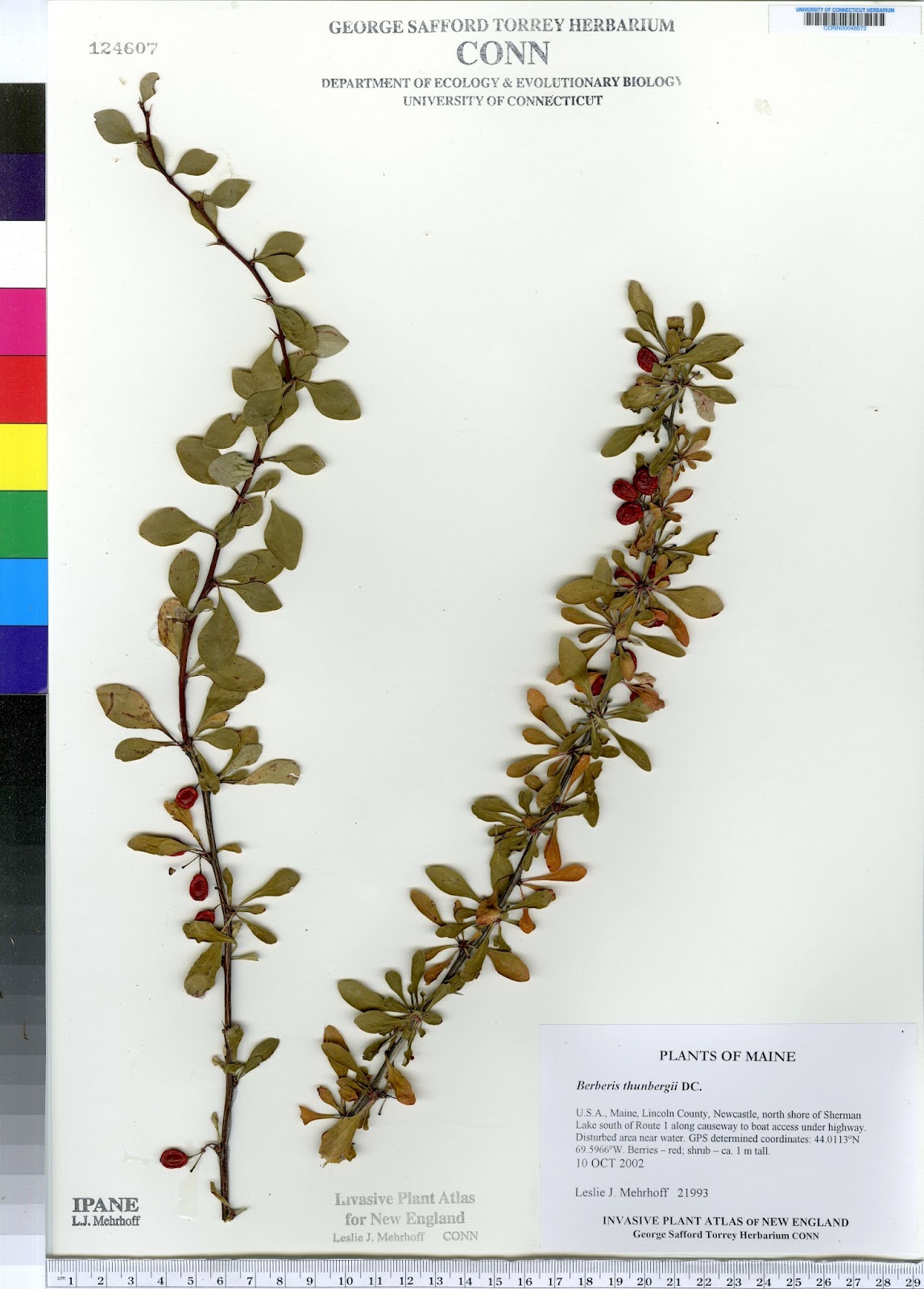
Ripe fruits on a specimen of Berberis thunbergii from the University of Connecticut herbarium

For the past year, Amanda Gallinat, Richard Primack and I have been evaluating herbarium specimens for about 60 common native and nonnative invasive species in New England for fruit ripening times. To understand how fruiting times have changed over time due to a warming climate, we have examined these museum specimens, which range in collection dates from the 1850's to present.

A full ripe specimen of Berberis thunbergii from the University of Connecticut herbarium online

In addition to the date the species was collected, each label on a specimen also provides information on the collector and location where the specimen was collected. We are especially interested to know if native species and invasive species are responding to climate change differently across the New England landscape.

A closer look at the label on the Berberis thunbergii specimen above